
California employers: your CCPA notice obligations are about to get bigger. 6 weeks to go.
Many employers still think the CCPA is a consumer-only law. It isn’t. Since January 1, 2023, California job applicants, employees and independent contractors have had the same privacy rights as any other consumer. If you’re a covered business, your HR data is in scope.
Here’s what the notice rules require right now, and what changes on January 1, 2027.
What the CCPA notice rules require
1. Notice at Collection (required now)
You have to give it at or before the moment you collect personal information. For applicants, that usually means with the job application. For employees, it means at onboarding. It must list the categories of data you collect, why you collect each one, and how long you keep it. If it’s a standalone notice, it must link to your full privacy policy.
The catch: you generally can’t collect categories of data you didn’t disclose. If your notice is out of date, every new data point you collect is a risk.
2. Privacy Policy (required now)
It must cover the whole HR relationship, not just your website visitors. Many employers combine it with the Notice at Collection, and that’s fine if it’s done correctly.
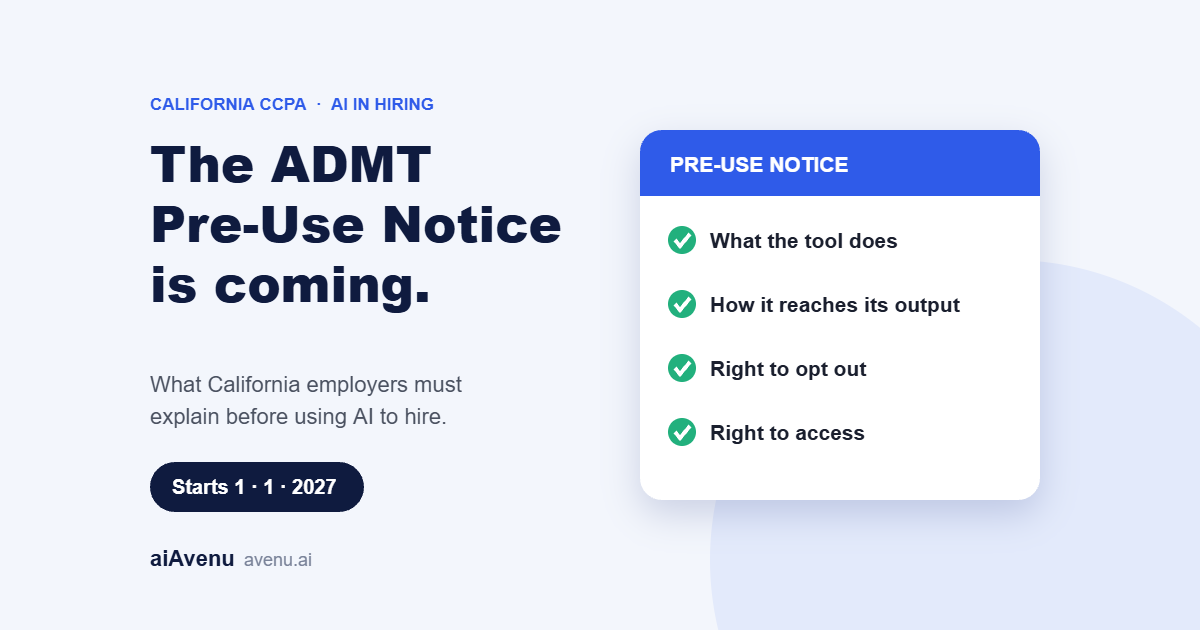
3. Pre-Use Notice for Automated Decisionmaking Technology (ADMT) (new as of January 1, 2027)
If you use AI or other automated tools to make “significant decisions” about people, including hiring, promotion, pay or work assignments, you must give a Pre-Use Notice before you use the tool. It has to explain:
- What the tool does and why you’re using it
- How it reaches its output and how that output is used in the decision
- The person’s right to opt out, or the specific exception you’re relying on
- The person’s right to access information about how the ADMT was used
This applies to tools you already use, not just new ones.
What we’re doing at aiAvenu as the system provider
Legally, the employer owns the notice obligation. But a notice is only as good as what the technology can actually explain. We built Avenu and our AI interviewer, Eva, so our clients can explain it:
- AI-use notices built into the workflow. Avenu sends candidates AI-use notifications and records their consent to recording and transcription before the interview.
- Evidence, not black-box scores. By default, Eva’s Evidence View shows how each candidate answered each question, based only on the interview transcript. It gives no numeric score and no recommendation. A human makes the decision.
- Transcript-only analysis. Eva doesn’t judge voice, appearance or video, and it doesn’t pull from candidates’ social media.
- No hidden rejections. The screening questions are written by the employer. Auto-reject is limited to hard knockout questions, and every auto-rejected candidate stays visible for review. We also removed bulk rejection.
- Regular bias audits. We audit quarterly. The audits cover the screener, the questions asked, and Eva.
- Access requests and records. We support access requests and keep records for 4 years, so clients have the documentation when someone asks how a decision was made.
- Accommodations. Candidates see how to request an accommodation before the interview. We’re also adding phone and two-way text interviews alongside video.
- Your data stays yours. We don’t use interview transcripts to train models.
My take as an attorney who builds AI hiring technology
Compliance is now a product requirement for AI hiring tools. If a vendor can’t show you exactly how its AI reached its output, you’ll struggle to write a Pre-Use Notice that holds up, and harder still to answer an access request.
Your checklist before January 1
- Inventory every tool that touches hiring or employment decisions.
- Update your applicant and employee Notices at Collection.
- Draft your ADMT Pre-Use Notice (it can be built into your Notice at Collection).
- Ask your vendors for documentation now, not in December.
This post is general information, not legal advice. Talk to counsel about your specific situation.
Kaylynn Kim is Founder & CEO of aiAvenu. This article was first published on LinkedIn.
Related reading
- Your ATS Is Now Regulated in California, Even the "Simple" Parts (also on LinkedIn)
- The Software Rejected Them, Not Us
#CCPA #ADMT #CPPA #AIinHiring #PreUseNotice #CaliforniaPrivacy #HRCompliance #EmploymentLaw #ResponsibleAI #HRTech